
Marilyn Monroe: Image, Persona, and Legacy
The approaching centennial of Marilyn Monroe offers an occasion to celebrate the global icon and reconsider a life and persona that remain as compelling as they are elusive. Few figures of the 20th century have been as widely photographed, circulated, and mythologized. Yet across the work of photographers such as Bruno Bernard, Milton Greene, Douglas Kirkland, Bert Stern, Eve Arnold, Philippe Halsman, Elliott Erwitt, and Lawrence Schiller, a more nuanced understanding emerges. Rather than a singular, fixed icon, Monroe appears as a dynamic presence shaped through collaboration, performance, and perception. Each photographer reveals a different facet of her: constructed and spontaneous, vulnerable and controlled, public and deeply private.
Born Norma Jeane Mortenson in Los Angeles in 1926, Monroe’s early life was marked by instability and time in foster care, offering little indication of the global figure she would later become. Her path to fame unfolded rapidly in the early 1950s as small film roles soon gave way to major studio productions such as Gentlemen Prefer Blondes and How to Marry a Millionaire. Alongside her film career, a steady stream of pin-up and publicity photographs circulated widely, helping define her public image and establish her as both a Hollywood star and a cultural phenomenon. By the mid-1950s, she had become one of the most instantly recognizable faces in the world.

Constructing an Icon: Bruno Bernard (Bernard of Hollywood)
Among the many photographers Monroe collaborated with, Bruno Bernard, known as Bernard of Hollywood, is often credited with shaping her earliest public image. Their collaboration, which began in the 1940s, was instrumental in shaping Monroe’s transformation from a model into a movie star. Bernard, known for his ability to combine innocence with a hint of glamour, recognized Monroe’s potential and took some of her earliest test photographs, which she later described as pivotal to the beginning of her film career. He also captured the iconic image Marilyn Monroe in White, depicting Monroe in a white dress standing over a subway grate during the filming of The Seven Year Itch. The photograph, which instantly became one of the most recognizable images of its time, was later chosen as the “Symbol of the Century” by the Museum of Modern Art in 1999.

Intimacy and Transformation: Milton Greene
Photographers often noted that Monroe did not merely pose; she transformed in front of the camera. This transformation is especially evident in the work of Milton Greene, whose close personal and professional relationship with Monroe yielded some of her most intimate portraits. In Greene’s photographs, particularly in the celebrated Black Sitting series (1956), shot in his New York studio, Monroe appears stripped of Hollywood ornamentation. One of more than fifty sessions the pair produced together, the series stands as one of their most intimate, raw, and sophisticated collaborations. Draped in dark fabric against a minimal black backdrop, she appears contemplative, almost inward. Greene later reflected that he sought to photograph “not the myth, but the woman,” and these images suggest a level of trust that allowed Monroe to momentarily set aside performance and explore stillness and artistry.

Awareness and Control: Douglas Kirkland
If Greene revealed Monroe’s capacity for introspection, Douglas Kirkland captured her acute awareness of the camera and her ability to shape the photographic moment in real time. When he photographed Monroe in 1961 on a set of white silk sheets for Look magazine, the resulting images became instantly iconic. Monroe is seen wrapped in luminous fabric, as if suspended between vulnerability and control. The session, often described as spontaneous, was in fact a carefully negotiated collaboration. Monroe arrived late, as stories often note, but once present she directed the energy of the shoot with precision. Kirkland later recalled how the shoot came about: “The shoot was at a photographic studio in Hollywood, and I knew the pictures I wanted to take of her but in my shy Canadian way I didn’t know quite how to get them. It was Marilyn who took charge: she said that we needed a bed and some white silk sheets, some Frank Sinatra records and a bottle of Dom Pérignon champagne. She had a robe on and eventually she slipped out of that and under the sheets, and that was how she wanted to be photographed,” a testament to her command of the photographic moment.
Vulnerability and Exposure: Bert Stern, The Last Sitting
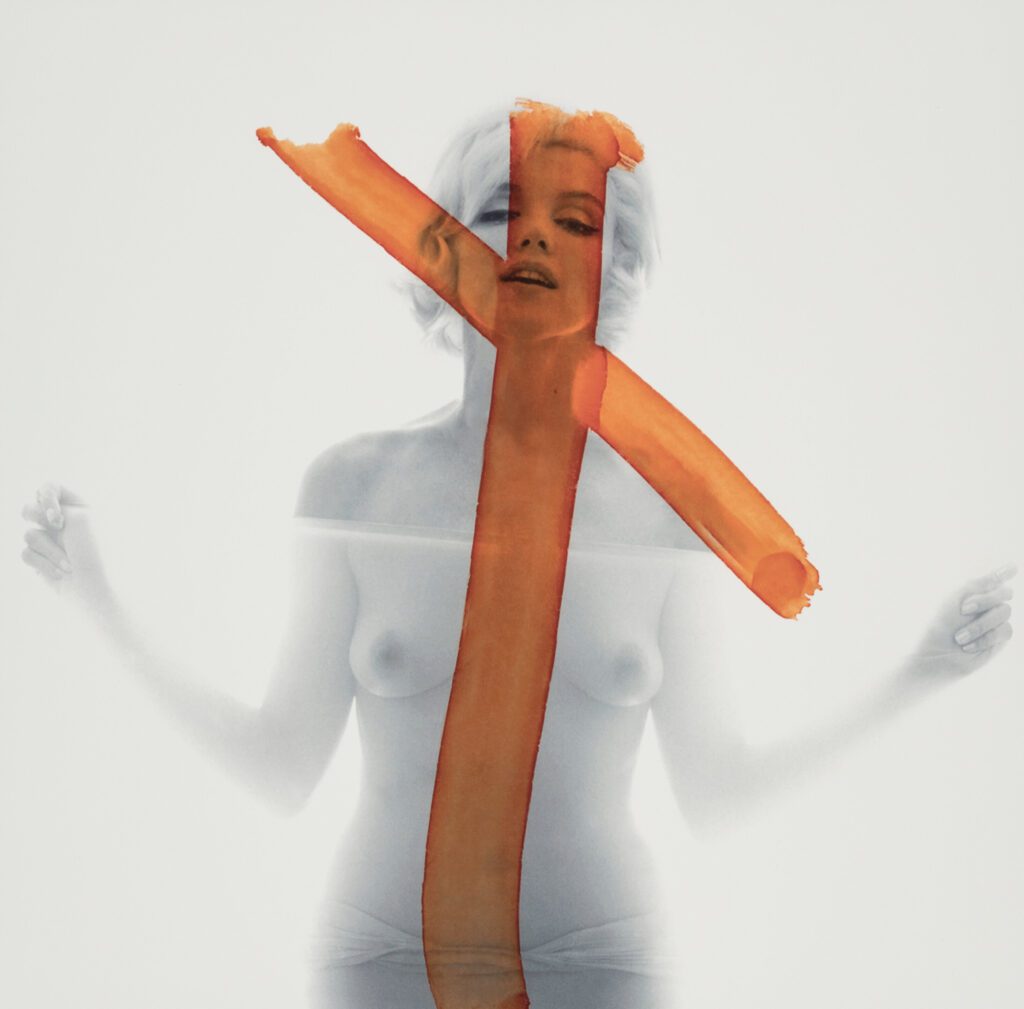
Kirkland’s photographs balanced intimacy with control, while Bert Stern’s The Last Sitting pushed this tension to its most extreme and revealing form. What began as an independent assignment for Vogue became a legendary series of more than 2,000 images shot over a three-day period, just six weeks before her death. Including the now-famous veiled portraits, the session oscillates between exuberance and fragility. In some frames, Monroe appears radiant and teasing; in others, her expression turns distant, almost withdrawn. Stern later reflected on the experience with a sense of awe, noting, “She was a dream… when she was there, she was completely there.” He also recalled how she reviewed the images, sometimes marking those she disliked, asserting authorship even in her final days. Considered the ultimate portrait session of Monroe’s life, the shoot encompassed fashion images, nude studies, and intimate portraits. Its raw, candid, and elegant nature transformed a magazine assignment into a profound historical and artistic record of Monroe’s final weeks.

Observation and Authenticity: Eve Arnold
In contrast to Stern’s heightened and emotionally charged session, Eve Arnold approached Monroe with a quieter, more observational sensitivity. A more observational, deeply empathetic approach defines the work of Arnold, whose long-standing relationship with Monroe produced some of the most revealing and unguarded images of her life. As a member of Magnum Photos, Arnold brought a documentary sensibility to her practice. This approach is particularly evident in photographs such as Marilyn Monroe and Arthur Miller Dancing, The Misfits, Nevada, 1960, where Monroe and Arthur Miller appear relaxed and playful, caught mid-dance in a moment of genuine ease. Rather than constructing a scene, Arnold allowed it to unfold, capturing a side of Monroe that feels spontaneous and joyfully unguarded. She once noted, “You don’t photograph people, you photograph their lives,” and in images like this, that philosophy becomes clear. The result is a body of work that reveals Monroe not only as a star, but as a person fully present in fleeting, unscripted moments.
Performance and Psychology: Philippe Halsman
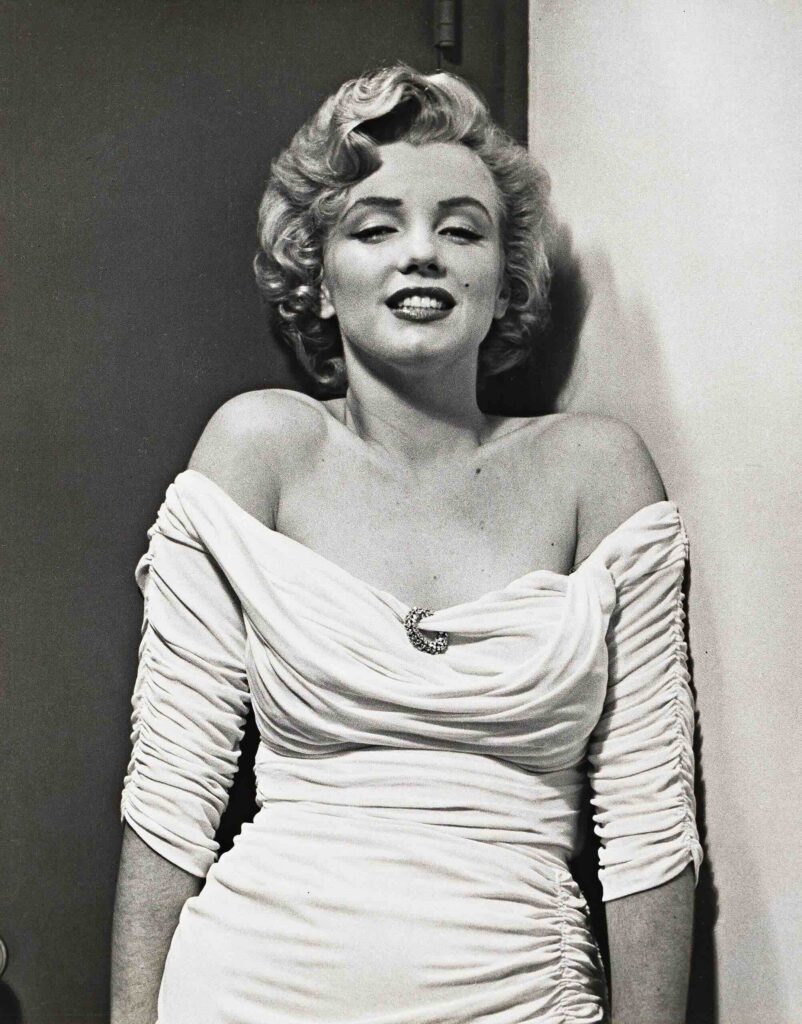
While Arnold emphasized spontaneity and lived experience, Philippe Halsman returned to the idea of performance, approaching Monroe through a more psychologically controlled lens. The notion of performance, central to Monroe’s cinematic career, also shaped her photographic presence. Halsman, known for his psychologically charged celebrity portraits, believed that a portrait could reveal inner truths through fleeting expressions, and Monroe proved an ideal collaborator. Her face, remarkably expressive, could shift in an instant from innocence to knowingness, as seen in Marilyn Monroe, 1952, which became her first cover for LIFE. Shot in her modest Hollywood apartment, the photo session marked a pivotal moment in Monroe’s career, launching her into superstardom. The intimate cover portrait highlights her natural charm rather than overt glamour, making it one of the most famous and collectible covers in the magazine’s history.

Restraint and Observation: Elliott Erwitt
Halsman sought to reveal inner truths through controlled expression, while Elliott Erwitt adopted a more understated and observational approach. A different sensibility emerges in the photographs of Erwitt, whose understated, often wry, observational approach set him apart from his more stylized contemporaries. As a member of Magnum Photos, Erwitt was less interested in constructing glamour than in observing it as it naturally unfolded. His images of Monroe, from the now-iconic subway grate scene during The Seven Year Itch (New York, 1954) to quieter moments, reflect this philosophy. Rather than amplifying her celebrity image, Erwitt treated Monroe with the same curiosity e brought to any subject. Even during his time on the set of The Misfits (Nevada, 1960), where he photographed Monroe alongside Clark Gable and Montgomery Clift, his lens remained attentive to human moments. The result is a body of work that centers on her magnetic presence, revealing a Monroe who is entirely at ease, rather than defined solely by her public persona.

Performance and Public Image: Lawrence Schiller
Erwitt observed Monroe with quiet restraint, while Lawrence Schiller captured one of her most overtly performative and media-conscious moments. A more overtly performative moment emerges in the work of Schiller, whose 1962 swimming pool photographs of Monroe, shot on the set of Something’s Gotta Give for LIFE magazine, stand among the final and most daring images before her death. During a filming break, Monroe had an idea that would generate immediate media attention, reflecting her instinct for shaping her own image at a pivotal moment in her career. She suggested that her character, who was supposed to jump into the pool, would come out nude, transforming a scripted scene into something spontaneous. Schiller, a young photographer at the time, described the experience: “Marilyn was a photographer’s dream subject with her clothes on and even more stunning with them off.” The resulting photographs remain remarkable not only for their boldness, but for the sense of control and vitality Monroe brings to them.
An Enduring Presence
As the centennial of Marilyn Monroe invites renewed reflection, these photographs collectively reveal a figure who was never fixed, but constantly in dialogue with the camera. Across each collaboration, Monroe emerges as an active participant in shaping her own image. It is this complexity that continues to define her legacy, ensuring that her presence endures as an ever-evolving force within the history of photography.