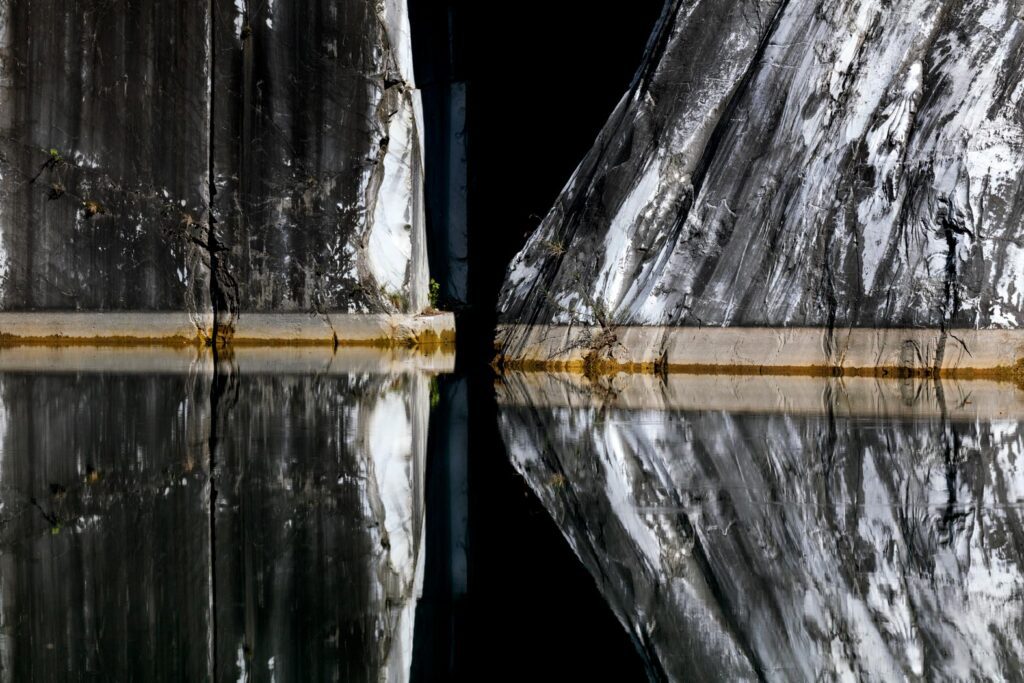
Francesca Piqueras and the Memory of Stone
Francesca Piqueras has long photographed the places where human ambition meets the resistant force of the natural world. Across shipbreaking yards, abandoned industrial structures, waves, dams, fire, and scorched terrain, her work returns to the same essential question: what does matter remember after it has been cut, burned, extracted, or left behind? In Inner Movement, that question becomes especially concentrated. Returning to the marble quarries of Carrara, Piqueras moves closer than before, closer to the rock itself, until landscape begins to dissolve into surface, scar, rhythm, and light.
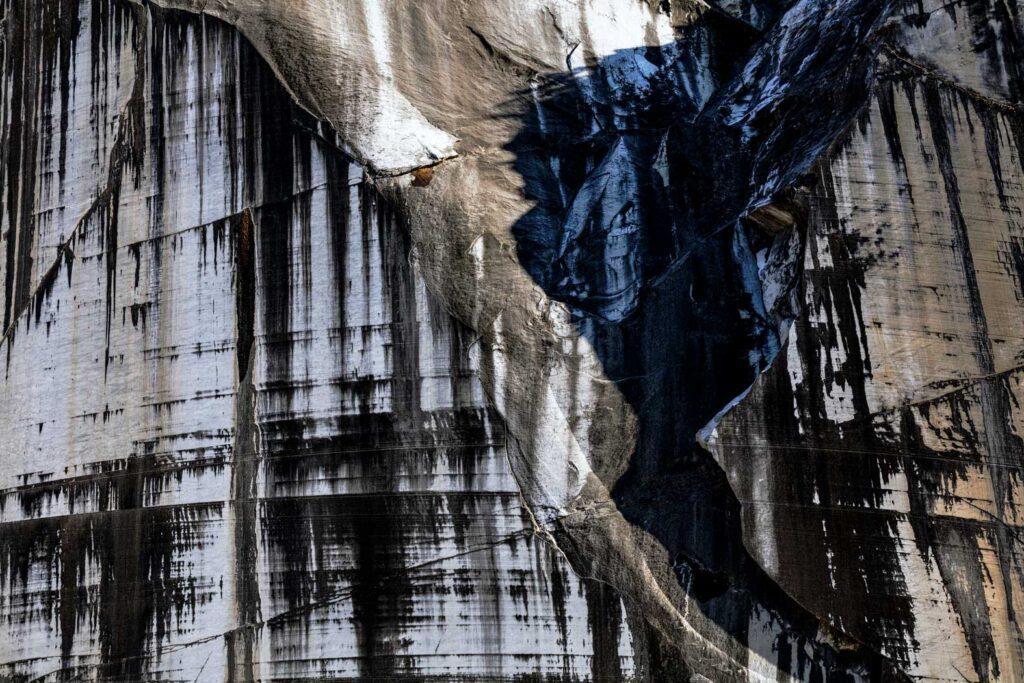
The result is a body of work that feels at once geological and pictorial. These photographs no longer present the quarry as a panoramic site of extraction. Instead, they isolate fissures, polished planes, dark seams, reflections, and abrupt cuts in the marble, transforming the mountain into a field of signs. One begins by looking for stone and ends by seeing something less stable: a kind of visual writing, poised between abstraction and record, between evidence and invention.
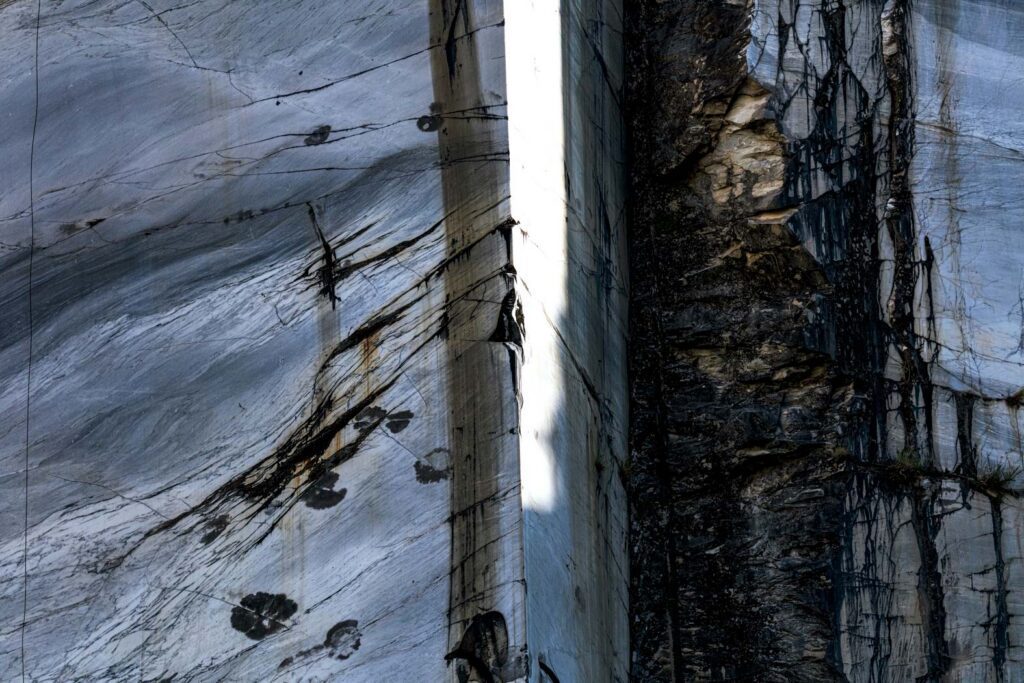
Closer to the Stone
Carrara has long occupied a privileged place in the history of art. Its marble gave physical form to ideals of permanence, beauty, and human aspiration. Piqueras approaches that tradition from another angle. She does not photograph marble as a finished monument, nor even as raw material awaiting transformation. She photographs it at the site of injury, where the mountain bears the marks of centuries of extraction and where the elegance of stone is inseparable from the violence required to obtain it.
This is what gives Inner Movement its unusual tension. The quarry is a place of cutting and removal, but Piqueras refuses spectacle. There are no workers, no monumental machines, no dramatic scenes of action. Instead, the evidence of intervention appears as fracture, abrasion, incision, stain, and polished face. Human presence is everywhere implied and nowhere shown. The mountain has become a palimpsest of pressure and force.
That restraint matters. By withholding overt drama, Piqueras allows the quarry’s surfaces to speak in a quieter but more unsettling register. The viewer is drawn into a space where beauty and damage can no longer be separated cleanly from one another.
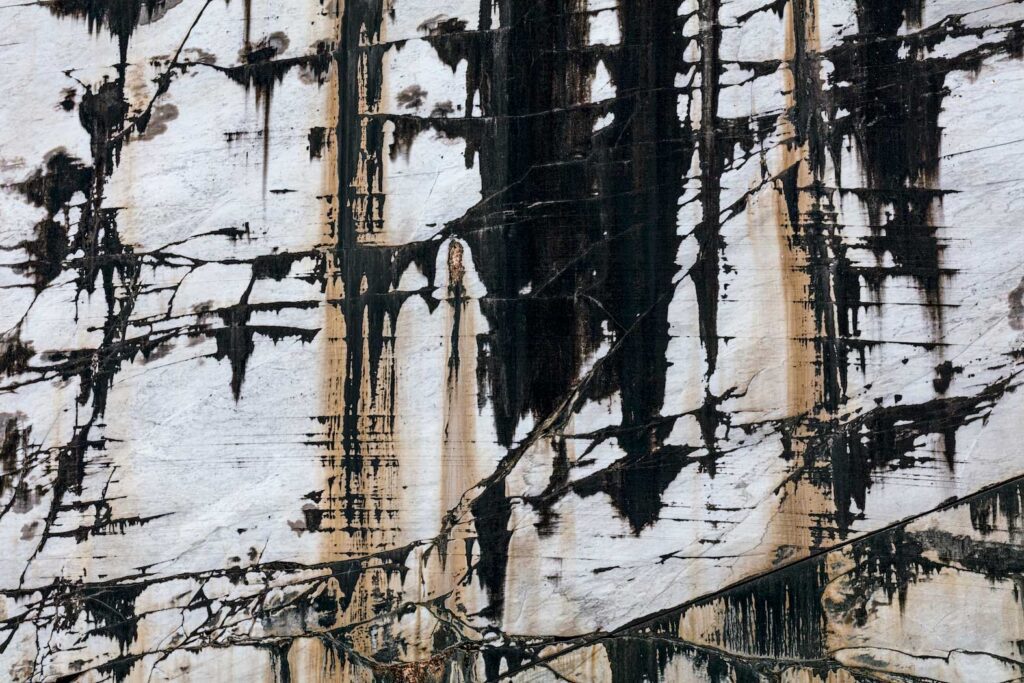
When Marble Turns Abstract
One of the most compelling aspects of Inner Movement is the way it unsettles the category of photography itself. Piqueras treats the camera less as a documentary instrument than as a means of reordering perception. Her close framings strip away ordinary scale and orientation. A dark vertical passage may read as an abyss, a reflection as a doubling of space, a web of mineral lines as drawing, or a smooth plane of marble as an abstract field. The eye moves across the image trying to decide whether it is looking at geology, architecture, painting, or memory.
That ambiguity is central to the work. Piqueras has spoken elsewhere about her desire to move close to matter, to the point of losing bearings and making the viewer lose them as well. In Inner Movement, that ambition is fully realized. The marble is no longer simply stone. It becomes image, surface, and event.
This tension between the descriptive and the abstract gives the series much of its force. Veins of black and gray streak across white stone like calligraphy. Reflected quarry walls create near-symmetries that feel almost impossible, as if the landscape were folding back on itself. Elsewhere, the polished faces of cut marble take on the stillness of minimalist painting, only to be interrupted by cracks, stains, and traces of erosion. Piqueras shows us a world in which matter seems to write its own history.
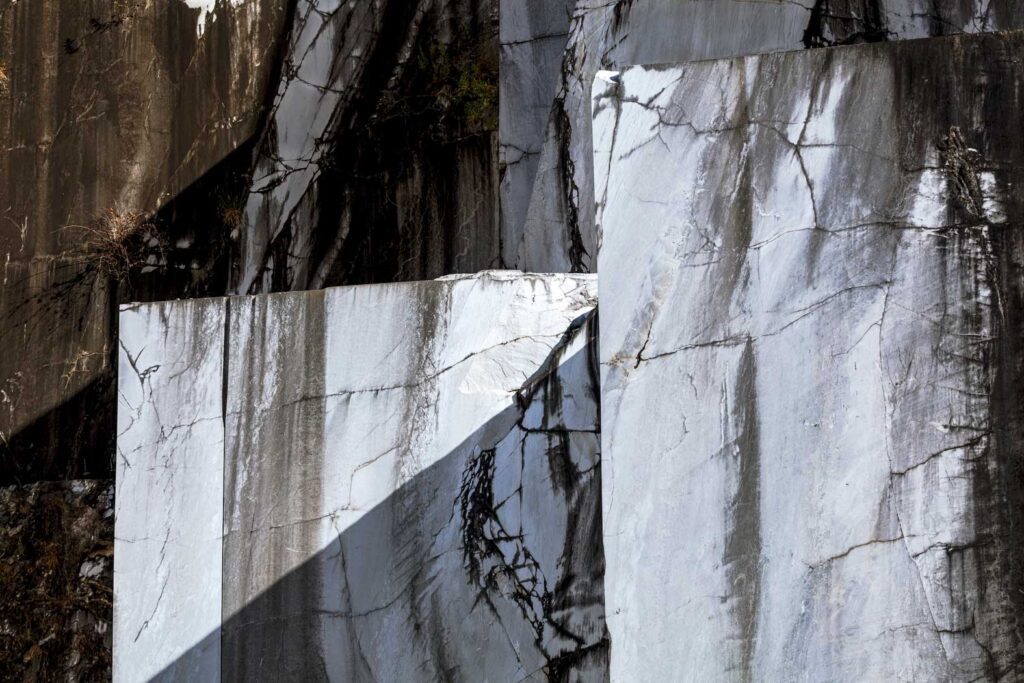
The Beauty and Violence of Extraction
Piqueras’s larger body of work is often discussed in relation to the Anthropocene, and rightly so. Her photographs repeatedly confront the reshaping of the earth by industrial, economic, and technological ambition. Yet what distinguishes her from more straightforward environmental image-making is that she does not illustrate damage in purely declarative terms. She is less interested in accusation than in transformation, in how the world absorbs human force and then reappears in altered form.
In Inner Movement, the Anthropocene is not presented through scale or catastrophe, but through intimacy. The camera moves close enough that the quarry becomes almost bodily. These are wounds, but also skins, membranes, and mineral tissues. The marble bears the marks of cutting, but it also resists, reflects, and persists. Piqueras is attentive to that paradox. Her photographs acknowledge violence, yet they also register resilience, metamorphosis, and the strange persistence of beauty.
This is part of what makes the series so affecting. It refuses both sentimentality and didacticism. The images neither condemn nor beautify simplistically. Instead, they ask what it means to look at a world in which creation and destruction are bound together, and in which human intervention leaves behind forms that can still arrest the eye with grace.
What Light Reveals
There is a deep intelligence in the way Piqueras uses light throughout this series. Light does not merely reveal the quarry. It activates it. It catches the slickness of cut marble, deepens the blacks of fissures, flattens certain passages into graphic design, and opens others into receding space. In some works, reflections produce a stillness so complete that the quarry appears doubled, suspended, almost unreal. In others, dark veining cuts across white stone with the force of ink on paper.
This is where Inner Movement achieves its fullest resonance. Piqueras is not only documenting an altered landscape, she is discovering a visual language within it. The quarry becomes a theater of line, fracture, tone, and echo. Scar becomes structure. Surface becomes memory. Stone becomes a site where time, labor, and perception are held together in uneasy balance.
What endures in these images is precisely that instability. One never settles fully into a single way of seeing them. They remain suspended between opposing states: abstraction and description, violence and elegance, monumentality and intimacy, geological time and present action. That is the particular strength of Francesca Piqueras’s work. She recognizes that the modern landscape is no longer innocent, yet she also knows that photography can still find in it a form of grave and searching beauty.